This is the third post in our series about building an AI Executive Assistant with OpenClaw. We’ve covered the overall architecture and the M365 integration. Now let’s talk about Micro Apps.
The help you need from an EA often isn’t about answering emails or scheduling meetings. You need it to help you work through longer projects, keep an eye on everything changing around you, and surface what matters at the right time. The hard part? These needs change constantly, sometimes daily. And there’s no time to wait on development cycles every time a new need pops up.
Apps Within an App
So we built a plugin with a companion application (web and mobile) that lets the EA or the executive create, use, and modify apps at any given moment. We call it Micro Apps. Apps within an app.
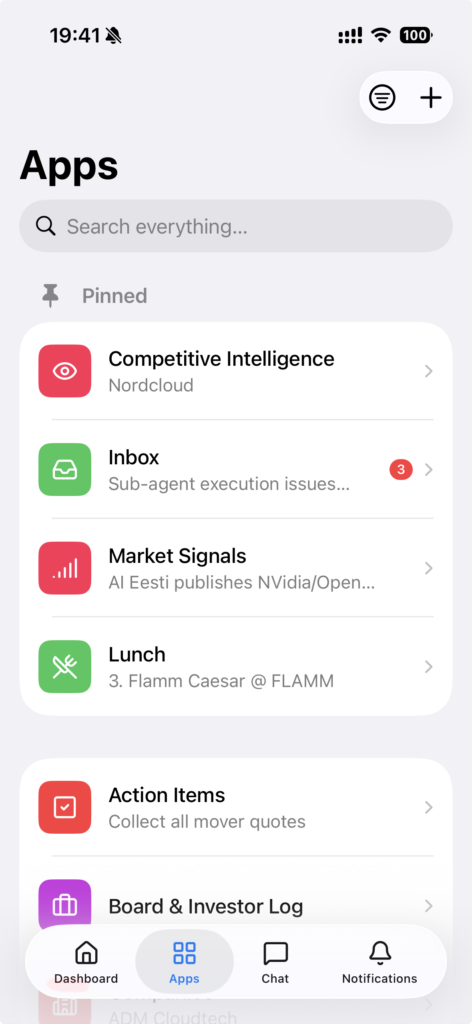
Behind the scenes, a team of specialized sub-agents handles different parts of the ecosystem. The builder agent constructs and updates micro apps based on our framework and templates. A project manager sub-agent handles larger tasks that span days or weeks, delegating to execution agents it can spin up in parallel. A researcher agent handles information gathering using all available research tools. There are many more, but the executive doesn’t need to know about any of this. They describe what they need, and it exists.
The builder is only as good as the templates it has to work from, and we haven’t figured out every use case yet. When a request doesn’t fit an existing template, the builder either misses parts of what was asked for, or improvises around the framework. Both happen. Mostly the improvised results stay within the wider framework and are usable. But it’s a clear sign we still have work to do on template coverage.
Every micro app supports push notifications and comments with agent tagging. See an entry and need more research? Tag the agent in a comment. Need to send that information to someone via email? Tag the agent. Want to publish it to the company website? Tag the agent. The context is already there, so the conversation is immediate.
Project-Based Apps
Some micro apps are temporary, built for a specific project and retired when it’s done.
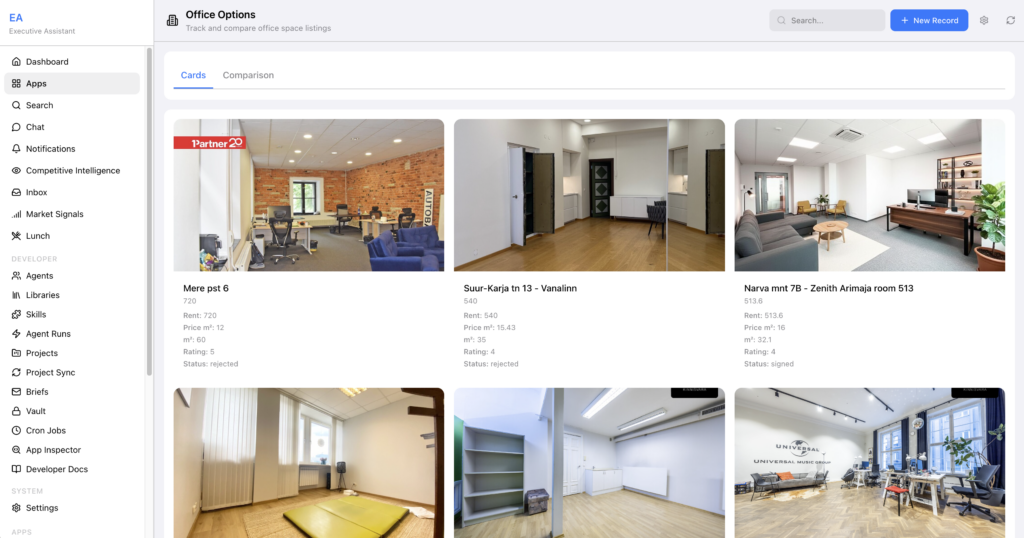
We recently went through finding new office space. A micro app monitored suitable listings on real-estate portals. New listing matching our preferences? Automatically added, notification sent. But it didn’t stop at monitoring. The same app tracked shortlisted options, communications with realtors, comparisons, and notes. A complete project management hub, built and running within minutes of deciding we needed it. When we found our office, the app had served its purpose. No enterprise software to decommission. It simply finished its job.
Permanent Monitoring Apps
Other micro apps run indefinitely. We have one that monitors our competition: new product launches, funding rounds, leadership changes, major partnerships. It surfaces the information with context and sends a notification. No manually checking competitor websites or setting up Google Alerts.
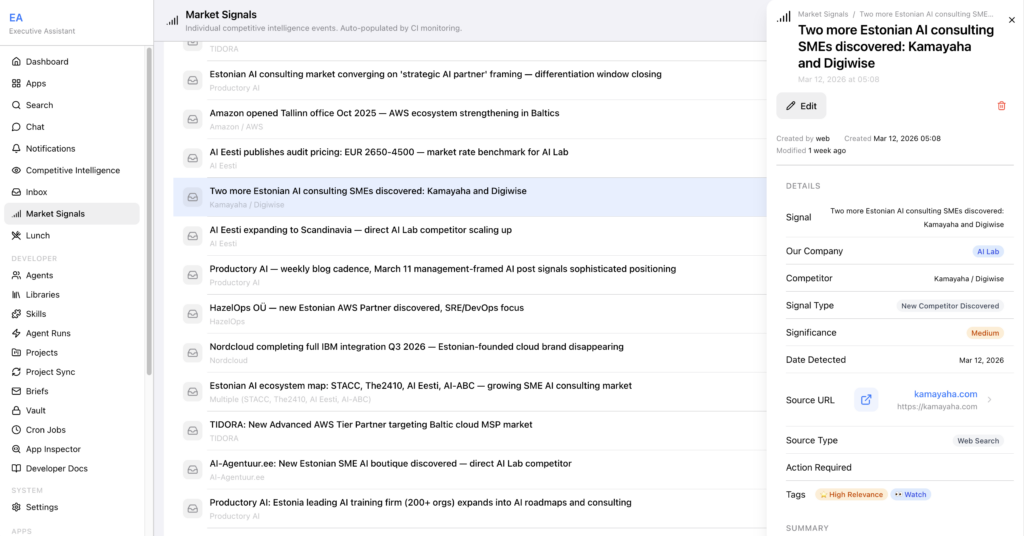
Another monitors the broader market for signals relevant to the CEO’s strategic priorities. When it finds something noteworthy, it doesn’t just dump a link. It adds the signal with context and its own research. Think of it as a research analyst who never sleeps and reads every relevant source in every language.
Morning Briefings
Separate from micro app monitoring, the EA delivers a morning briefing every day based on a different set of sources entirely: news outlets, social media platforms, and specific websites that matter for the executive’s field. In our case, LLM provider announcements, European regulatory updates, industry publications, and similar sources.
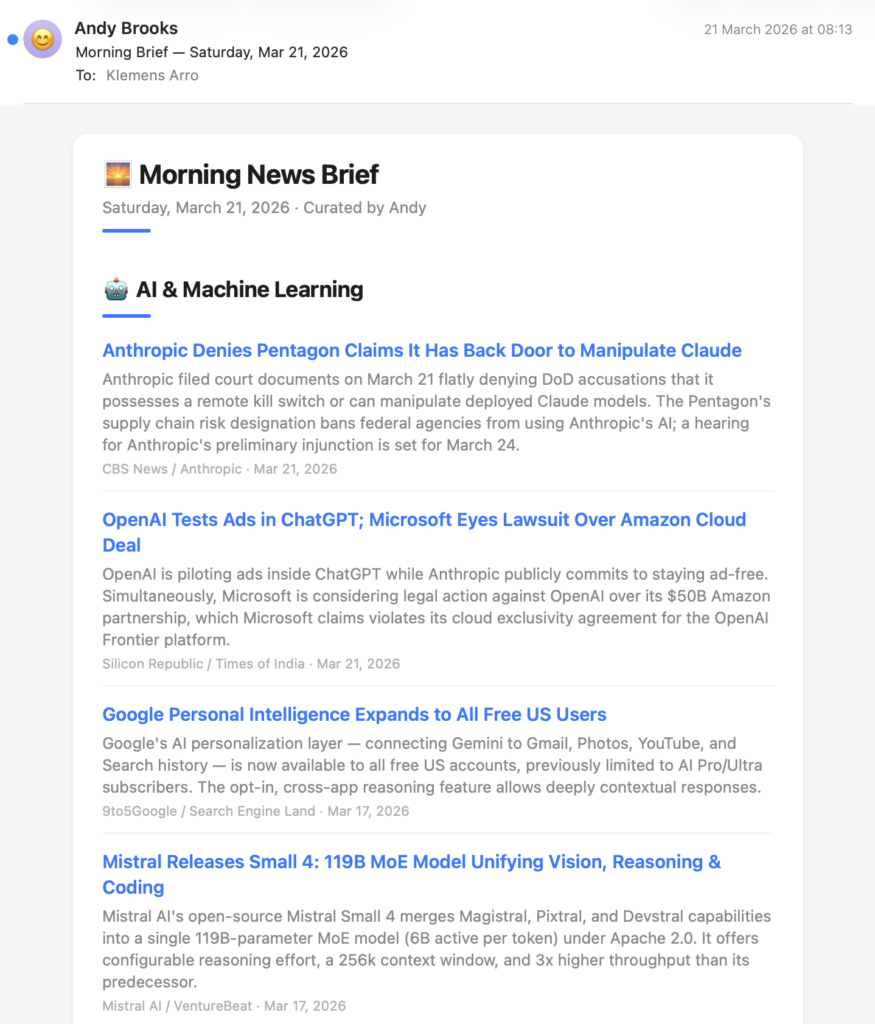
The EA identifies relevant channels and accounts on social media, monitors them every morning, and surfaces anything noteworthy. The key value isn’t gathering. It’s prioritization. The agent knows the executive’s role, their field, and what actually matters to them, so it filters everything through that lens. The goal is a clear picture of what’s happening, without scanning dozens of sources yourself.
And because it’s built on an LLM, there’s no language barrier. Sources in Chinese, Estonian, Ukrainian, whatever is relevant, all presented in the executive’s preferred language. A regulatory change in Brussels and an AI announcement from Beijing show up side by side.
Why the Framework Matters
The real power of Micro Apps isn’t any single app. It’s the speed. Traditional approaches involve requirements gathering, development, testing, deployment, training. Even with low-code platforms, you’re looking at days or weeks. With Micro Apps, the executive describes what they need, and it exists.
But the consistency you get comes specifically from the framework. Without it, things look very different. Ask the agent conversationally to “send me a morning brief about these five news sources every day,” and some mornings it covers three sources, the next morning all five, the morning after that it changes the format entirely. No framework defining the output means the agent interprets it differently each time.
This is exactly what Micro Apps solve. When a task runs through the framework, it follows the same protocol every time: same structure, same data flow, same output format. The framework removes the ambiguity that causes drift. For ad-hoc processes that live only in conversation? Expect inconsistency.
We’re constantly expanding the framework. There are many more micro apps running now, monitoring internal and external factors, notifying me whenever something needs attention. Each one built in minutes, running autonomously.
Share this article